RV Tech · Power
The fault that started all of this
An inverter that tripped on every compressor start, a corroded lug hiding in a cable run, and how the cable became a sensor.
The MultiPlus tripped on "low battery" every single time the air conditioner compressor kicked on. With a full bank. It was not the batteries.
Not the battery — and not really the cable either
The battery run was dropping roughly 1.5 V under the compressor's ~135 A inrush — enough to pull the voltage at the inverter's own terminals below its low-voltage cutoff while the battery itself sat happily at full charge.
The obvious reading was "undersized cable", and that is what we assumed at first. It was wrong. The run was 4 AWG rather than the 6 we thought, and more importantly the copper was only about half the problem. The rest — roughly 2.6 mΩ of it — was sitting in one corroded connection where a 4 AWG cable landed on the bus bar.
Put a number on what that means. At 125 A, 2.6 mΩ in a single lug is 0.33 V dropped and 41 watts of heat being dissipated inside one connector. And it is self-accelerating: heat grows the corrosion, corrosion raises the resistance, higher resistance makes more heat.
The rebuild replaced the run with 1/0 and cleaned the joint. Both mattered; the joint mattered more.
If your inverter trips on startup surges, meter the DC voltage at the inverter's terminals during the surge — not at the battery. Then find out where along the path the voltage is disappearing, because a bad joint and a thin cable look identical from the ends.
Now the cable is a sensor
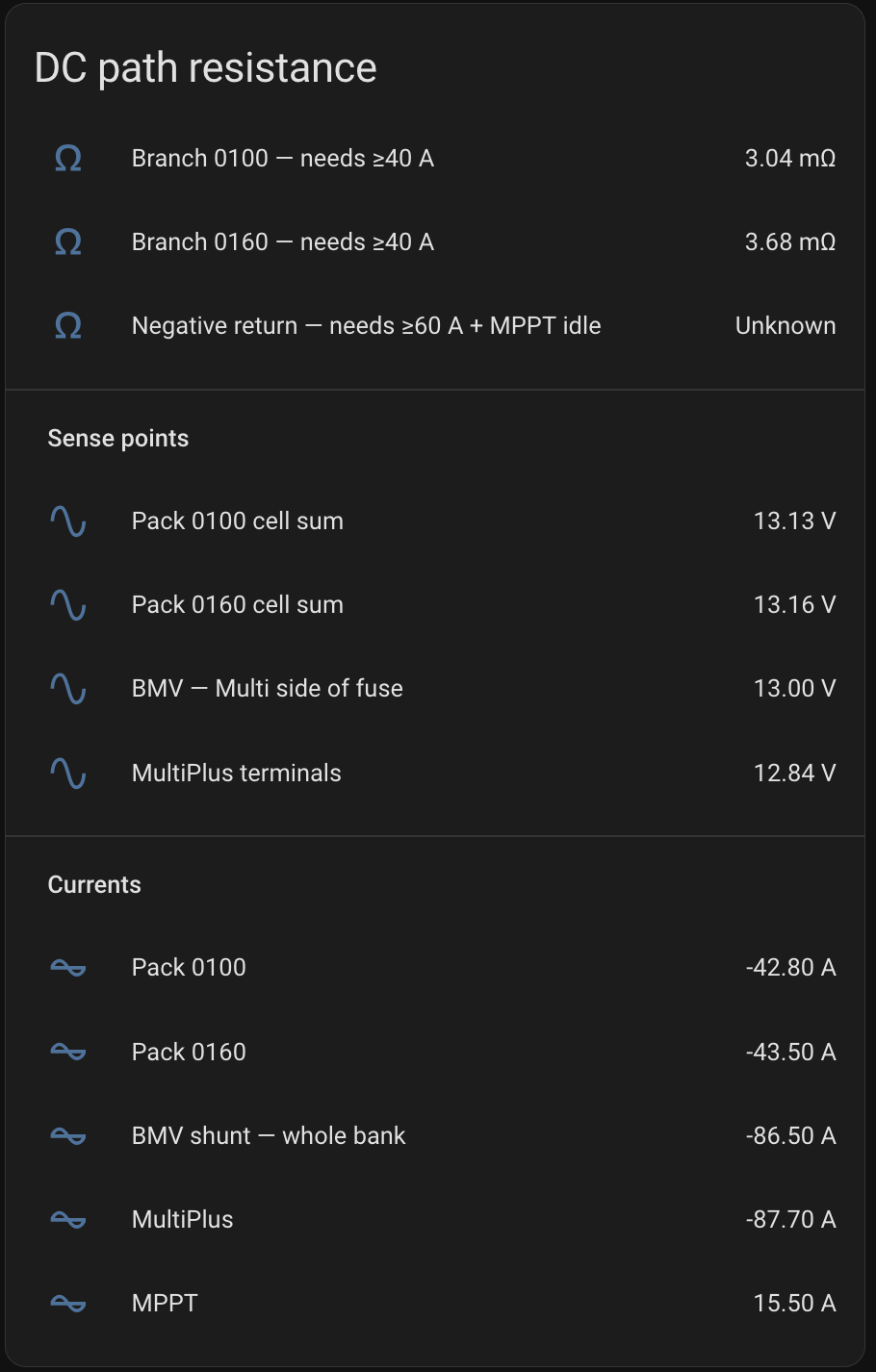
Rather than trusting that the repair holds, Home Assistant continuously computes the resistance of each battery cable run — voltage drop divided by current, in milliohms. A corroding lug or a pitted connector now announces itself as a slowly rising number, weeks before it can strand anyone.
It only computes above 40 A. A voltage drop measured at 5 A is mostly rounding error wearing a convincing costume.
Cell spread, with a diagnosis attached
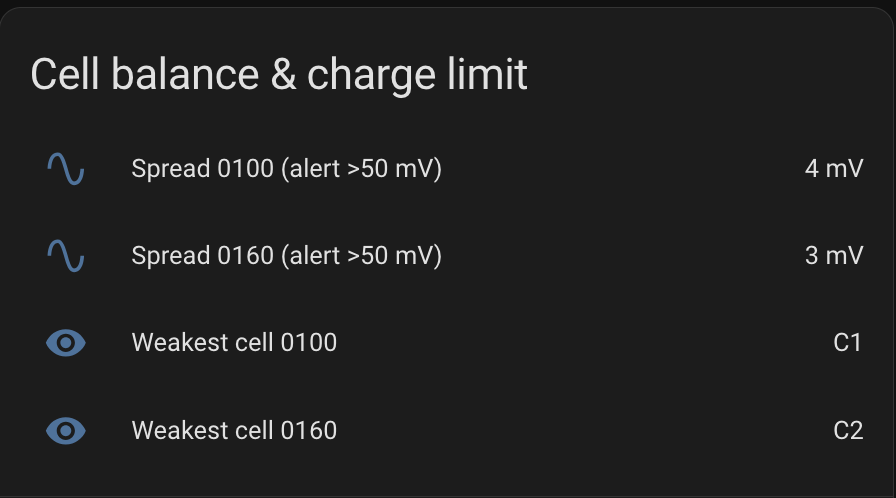
An alert fires if either pack's cell spread holds above 50 mV for half an hour — it sits around 2 mV at rest. The alert names the weakest cell, because the pattern is what matters. If the same cell is repeatedly the outlier under comparable charge, temperature and current, that points at a persistent imbalance, a sense-path problem, or a weakening cell — run the manufacturer's balancing procedure and escalate if it persists. If the identity wanders at small spreads, that is ordinary measurement variation. A single reading tells you very little; spread under an 87 A discharge means something different from spread near the top of charge.
"Your bank never actually finished charging"
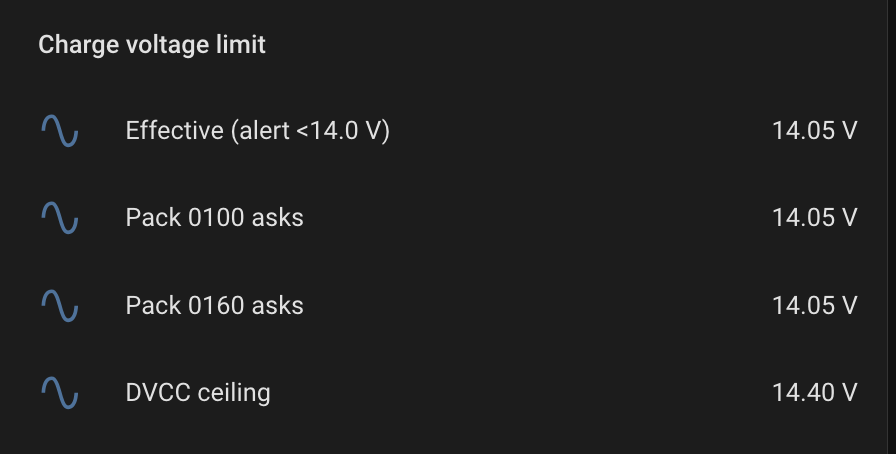
If the effective charge voltage limit drops below nominal while current is actually flowing in, Home Assistant says so and names which of the two packs is holding the bank back. Without that, you simply stop reaching a full absorption cycle. Nothing alarms, your state-of-charge calibration quietly drifts, and balancing suffers for months.