RV Tech · Solar
The failure that hides from every alarm
A burned SAE connector on the roof that never blew a fuse, and the health sensor built so it cannot happen quietly again.
A high-resistance joint in a solar string is genuinely nasty. The string self-limits to almost no output while still generating heat, so no fuse opens and no controller alarm fires. You just quietly lose a third of your array and never find out.
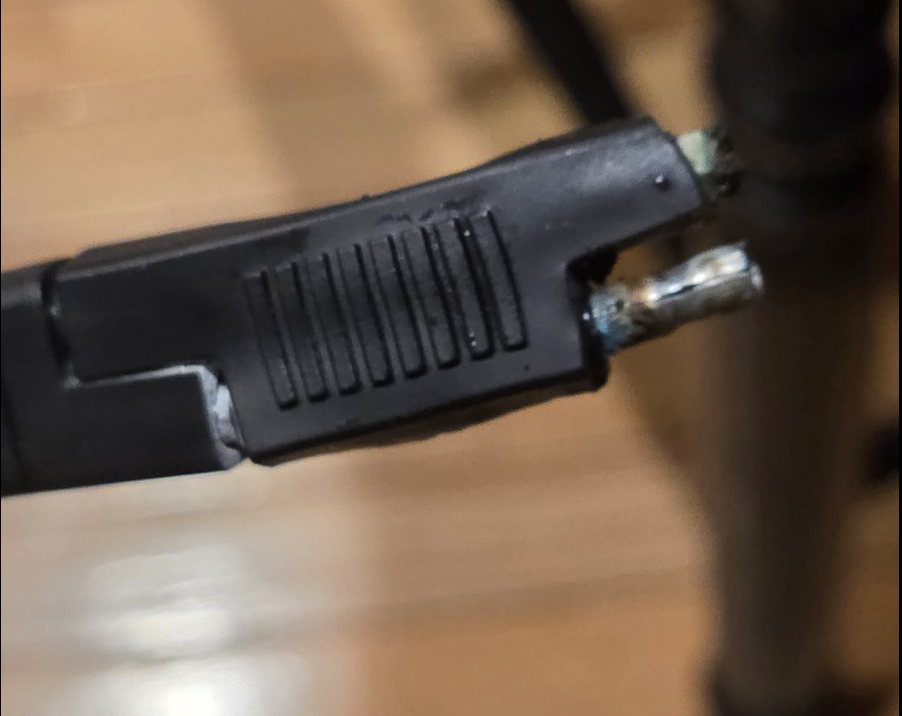
We found one the hard way: a burned SAE connector on the roof, charred through while still mated to its cap, one contact destroyed with green corrosion.
The likely initiator was mechanical — a branch catching the cable and pulling the connector partly out. Not far enough to disconnect anything, just far enough to reduce the contact area. That is the worst version of the fault: a fully open string stops contributing power and is therefore easy to spot, while a partly seated one keeps carrying current through a smaller contact patch, concentrates heat at that contact, and lets water into a connector with no published ingress rating. Heat and corrosion then feed each other until the housing melts.
To be clear, an open string is easier to detect, not harmless — a disconnected panel in daylight is still an energised DC source.
It is a fire risk, not a yield problem — and worth a look after any drive under low branches.
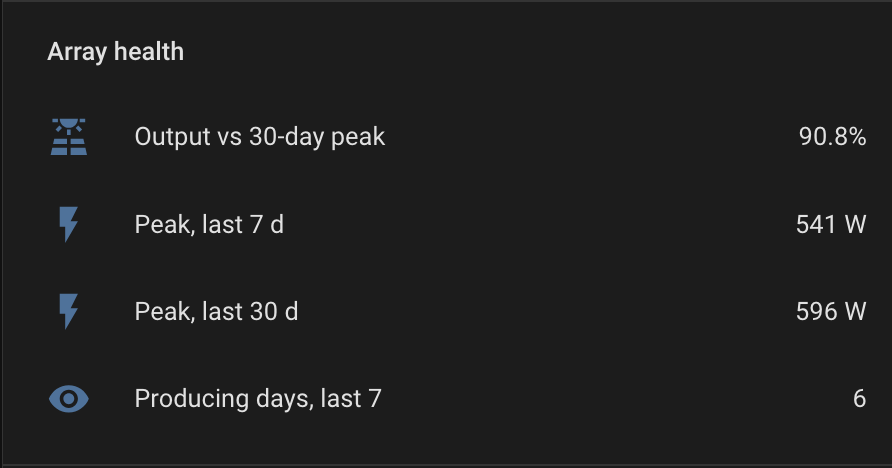
So Home Assistant now tracks solar output health: the trailing 7-day peak output as a percentage of the trailing 30-day peak. Peaks rather than averages, because one clear hour in a week restores a peak — weather matters far less than it would to an average, though a genuinely cloudy fortnight can still pull it down. It also refuses to report at all when the rig is stored or shaded, rather than screaming that the array is dead.
What a failure looks like depends on which string goes. Ours are not equal — 400 W, 200 W and 320 W — so losing one leaves roughly 57%, 78% or 65% of nameplate respectively. String C, the one that actually failed, sits in the mid-60s. Treat this as a fault detector, not a power estimator: all three strings share one controller and do not have identical operating voltages, so they cannot all sit at their own maximum power point at once.
De-energise the array at the DC-rated string disconnects, or cover the panels, before servicing anything on the roof. Never separate PV connectors under load.